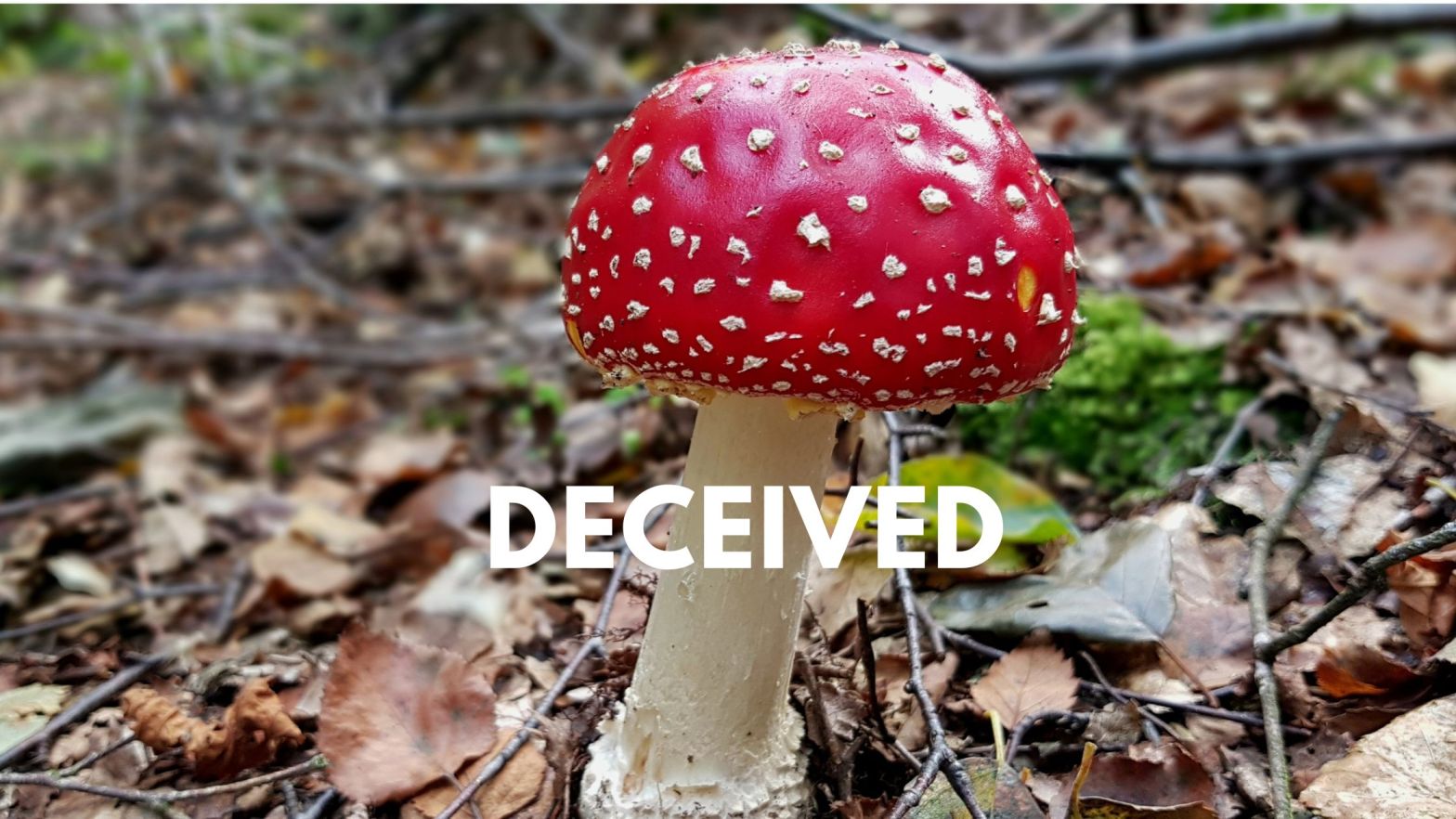
Last time we looked at the snake in the garden of Eden and wondered why we would fall for his lies? Continuing to focus on ourselves first, before pointing any fingers, I want to think about this question, and to that end, I want to consider seduction. The online dictionaries tell us that to seduce is to:
lead astray by persuasion or false promises
to corrupt, tempt, win over, attract, entice or lure
to persuade to disobedience or disloyalty
to lead or draw away, as from principles, faith, or allegiance
It sounds familiar, does it not? I know I have succumbed to some of those, often! By any means at his disposal, our enemy will work to seduce us into temptation, to lead us astray, to deceive. In looking at his seduction, I was drawn to Proverbs 5:1-6 ESV. I know the picture is of the seduction of a young man by a “forbidden women” but this is how I imagine it was in the garden of Eden.
My son, be attentive to my wisdom; incline your ear to my understanding, that you may keep discretion, and your lips may guard knowledge.
For the lips of a forbidden woman drip honey, and her speech is smoother than oil, but in the end she is bitter as wormwood, sharp as a two-edged sword. Her feet go down to death; her steps follow the path to Sheol; she does not ponder the path of life; her ways wander, and she does not know it.
We could easily substitute Satan for the forbidden woman in this passage. The snake’s slithery tongue dripped seductive lies, that seemed sweet, that drew them in with smooth speech, but the end of it was indeed bitter, dividing them from the Father, robbing them of life, access to the garden and all that is good. As we continue to look at the story of the fall, I want to consider another scripture, from 1 John 2:16, which also contains a warning:
For all that is in the world – the desires of the flesh, the desires of the eyes, and the pride of life – is not from the Father but is from the world.
Another translation puts it this way:
For the world offers only a craving for physical pleasure, a craving for everything we see, and pride in our achievements and possessions. These are not from the Father, but are from this world.
John contrasts the lure of worldly things with that the Father’s kingdom. These are same temptations that the enemy tried with Jesus, and failed! When we look at this verse in the light of the temptation in the garden, in Genesis 3:6, we can see a parallel with what John is talking about. Adam and Eve were seduced by these worldly things.
When the woman saw that the fruit of the tree was good for food and pleasing to the eye, and also desirable for gaining wisdom, she took some and ate it. She also gave some to her husband, who was with her, and he ate it.
Craving is such an apt word. To crave means to have an intense, urgent, or overpowering desire for something, often dominating thoughts. I remember the intensity of pregnancy cravings. It feels all consuming. Craving signifies a deep longing for food, substances, or abstract needs like affection and attention. When I am tempted by something, it goes round in my mind before there is any action. It does dominate thoughts.
A fleshly desire for what “tastes good” – what pleases our bodily appetites. Those of us with a sweet tooth can attest to the power of that temptation when trying to resist the delicious looking desserts at the end of a meal out. “Just one mouthful” can soon become two or three, “just one more drink” becomes a regular bottle, and so on. They become a trap. These desires seem insatiable. The things we try to satisfy them with don’t seem to be enough.
Our TVs and social media abound with things that look good to our eyes, that are designed to turn our attention towards to the beautiful and the shiny, the latest must have thing that looks amazing. Advertising relies on appealing to our senses, our desires, with seductive pictures, sounds and words to lure us towards whatever product is being marketed. Fortunately not everything that is being marketed is evil. However, King David could warn us about the perils of a roving eye alighting on a beautiful woman. More forbidden fruit. The fact that it is forbidden, seems to make it more attractive, for some.
The ‘pride of life’ that caused Satan’s downfall seems to be woven into our hearts. It was also King Saul’s downfall. He wanted to look good in front of the people, to keep his status, to not lose his power. The self-focus, that makes us want to succeed, to look good, to have special knowledge, the power of status, to be on the inside track. We want to be significant, to show that that we are wiser, smarter, richer, more powerful, or somehow better. To have evidence that we are winning at life, that we are a success.
What would Satan know of leading us to true life? How could he possibly lead us into truth? He can’t, he is incapable of telling the truth. His ways bring death and destruction always as Jesus tells us in John 10:10. Jesus is the only one who is the way, the truth and the life.
The thief comes only to steal and kill and destroy; I have come that they may have life, and have it to the full
However, temptation is not temptation if it is not tempting. It must meet some need in us. It starts with a desire that it appeals to. We have legitimate basic needs – for physiological things like the need for air to breathe, water, food, sleep and so on. We need environmental things like safety, shelter, warmth, and things that relate to our health and well being. We have relational needs for connection, belonging and acceptance. We have a need for significance, for respect, for recognition from others. We need things like purpose, creativity, love, joy, peace and so on. These are all genuinely part of being human.
Strictly speaking sin is when we are tempted to fulfil those needs outside of the parameters of the Kingdom of God, outside of our Father’s house. Temptation is not sin but giving in to temptation is. The need is not wrong, the desire for comfort, or significance, or security is not wrong in and of itself, but the way we go about getting that need met matters. There are good, godly ways to fulfil our needs and then there are other self-centred, ungodly ways. 1 John 3:7 warns us:
Dear children, do not let anyone lead you astray.
Within the garden, all of their needs were being met perfectly within the context that God had created. He had provided for their every need, including the moment when he decided that Adam lacked a companion, someone to do life alongside him, to share the responsibility for reigning over the garden they had been given. Satan seduced them into believing not so much that they weren’t provided for but that God was holding out on them, that they were missing out. That they could have, and be, more.
I remember as a teenager wanting to have nothing to do with God because I believed that life was better without him, that following Jesus would mean missing out on all the ‘fun’. I wonder whose lies those were that were planted in my mind. Satan works hard to persuade us, whatever way he can that life is better without God, that we don’t need him, that there is more pleasure to be had outside of the parameters of his safe boundaries. Honestly, some of ways we have presented the gospel have felt very uninviting. The gospel did not feel much like good news in that moment. But then Satan is not averse to putting us off with a liberal dose of religiosity for good measure.
How easily we are convinced that freedom looks like doing exactly as my flesh desires in the moment – regardless of the consequences for myself or others. Often our pride, our rebellious nature, rises up to lead us down the path of “life” which looks like self-indulgence, like “don’t tell me what to do”. What we don’t realise is the consequences of our choices until we are living in them, and they usually last a lot longer than the moment of temptation that we give in to.
So, we are still eating from the tree of the knowledge of good and evil in the brokenness of our world. Still deciding we know what is good or bad, still measuring our lives at every moment, and everyone else’s performance too. (This fact is some of what started my quest to look at deception.) What a fractured world. Disconnection from God, from each other and from the ways God intended things to be has brought temptation to our door like God told Cain in Genesis 4:7b
… sin is crouching at your door; it desires to have you, but you must rule over it.
That’s easier said than done. For myself, I know that the times I am most vulnerable to giving in to temptation are when I am bored, lonely, angry, sad/stressed or tired (BLAST). Some of us need to add H for hungry in there too! It is good to be aware of our vulnerabilities, of the areas that we are most likely to be tempted and have strategies in place to help us but the futility of trying hard in our own strength to resist temptation is what has most of us giving up New Year’s resolutions by January 5th!
However, the good news of the gospel is that Christ has overcome the world, the flesh and the devil. Our enemy is a defeated enemy. The good news is that God’s provision extends us the grace we need to resist temptation. He knows that we are weak and he has given us the power and the strength we need through his Holy Spirit to stand firm, IN Him. It is our abiding in him, in his strength, that enables us to resist.
We will pause here with these verses in James 4:6-7 that encourage us to humble ourselves and call on his help, showing us the real strategy for winning at life, and overcoming the seduction of the enemy. Next time, there is much more to be explored in terms of our vulnerability to deception. Until then, let’s sit in his grace!
But he gives us more grace. That is why Scripture says: “God opposes the proud but shows favour to the humble.” Submit yourselves, then, to God. Resist the devil, and he will flee from you.

