Last week I ended with a prayer for God to keep my heart teachable. I have been thinking about that more. In the process, I have become aware that I categorise people in my life. I rank them subconsciously in terms of those whose opinions I value, those I give permission to speak into my life (whether or not they are aware they are doing so).
There is a sense where that is not so wrong. Partly because I have a limited amount of time and it is good to maximise the potential good that I am receiving but also because the book of Proverbs has much to say about those that I ‘keep company with’ (whether in reality or virtually), for example, in chapter 13 verse 20:
Walk with the wise and become wise, for a companion of fools suffers harm.
Paul exhorts his readers in one of his letters, to emulate his lifestyle. If someone’s lifestyle glorifies God and challenges me in my walk with Jesus, then I am going to pay attention to what they say. There is a lot of chatter in the online world, a lot of teaching, and comment in general. It is wise to be discerning about what we are listening to. 1 John 4:1 encourages us to test the spirits. Sometimes things sound right, even are right, but the spirit behind them is wrong, as we see in Paul’s reaction to the fortune telling slave girl in Acts 16. The Bereans were commended by Luke in Acts 17 for checking out what they had heard against the scriptures, and in 1 Thessalonians 5:19-20 we are advised:
Do not treat prophecies with contempt but test them all; hold on to what is good …
However, I follow the God who spoke to one man through a donkey (granted he was not being very attentive at the time) and through a fiery angel in a bush at another time (maybe donkeys were scarce in the desert in Moses’ time!) He can speak through whoever or whatever he likes. I remember God challenging me years ago as I drove to our annual ecumenical “churches together” service in the town’s abbey. I was not feeling very enthusiastic, and God asked me if I thought he could not speak to me there. My expectation of meeting with him in that service was non-existent I have to confess, but I did.
God can and does regularly speak to me through the most random of things – secular songs, signs, creation, overheard conversations, etc. And why not? So, it is not that I don’t believe that he can speak to me through anyone, it is that somewhere there is a pride, an arrogance in me that says I don’t believe you have anything to teach me. That’s what it boils down to at its root. Somewhere, there is a judgment, an appraisal of the person that results in me finding them less than in some way. There is an unconscious understanding that somehow, what they could teach me I am “beyond” in some way.
I think that a good way to counter this in myself is to ask God what he appreciates about the people I encounter, what I can learn from them, what are they good at. The benefit of this is two-fold. It makes me notice people and see them through his eyes and affords me the opportunity to encourage them through what God shows me, but it also keeps me from that proud, arrogant thinking.
Humility is a heart posture. If pride is about loftiness, about being high and mighty, humility is about bowing down. It means that the part of me on the inside that wants to stay standing, that I mentioned last week, is made to sit down. Jesus urges us in Matthew 11:29
Take my yoke upon you and learn from me, for I am gentle and humble in heart, and you will find rest for your souls.
How can I learn from him if I am not teachable, humble enough to acknowledge I have things to learn? I don’t know everything. The word he uses for humble literally means low. To me the classic posture of the teachable heart, of humility, is Mary in Luke 10:39.
… who sat at the Lord’s feet and listened to his teaching.
In my own life this looks like not always being the one to tell other people how to do things but being willing to let someone show me how to do something. It looks like me allowing someone else to contribute, an opportunity to shine. Even if I think I already know, sometimes I might just learn something new. It looks like not always voicing my opinion, or at the very least leaving space for others to voice theirs. I don’t always have to be heard. It doesn’t always have to be done my way. It looks like choosing to focus on the person in front of me and not scanning the room for better options. It is good to hang around giant killers if you want to learn to kill giants, but motivation is everything and so it’s good to kill off the giant of pride in my own heart first. I think unteachability in my heart can have much to do with a desire to look good in front of others and not acknowledge anything that could be construed as weakness, to be seen among the “giant killers”.
I came across a verse this week that must have been updated on my online version of the bible as it differs from what is in my real, paper bible. It makes sense when I think about it. I guess in my head I had not particularly connected the two as they are in Proverbs 22:4
Humility is the fear of the Lord; its wages are riches and honour and life.
Fear of the Lord was this weird, nebulous thing that I didn’t really get for a long time, at least not in a way that I could put into words. This version of this verse has helped me. Fear of Lord is about respect, awe, and honour and all those things but actually this verse has made me able to articulate it more helpfully in order to bring it into my life practically. Proverbs 9:10 begins
Fear of the LORD is the foundation of wisdom.
Remaining teachable is indeed the beginning of wisdom. Fear of the Lord, humility, is the acknowledgement of my need of him, my dependence upon him for my every breath. It is the acknowledgement that I do not know everything and he does, and that he is my source of all things good, all things wise. It is the acknowledgement that I still have so much to learn. It is acknowledging that I am dependent on Holy Spirit, my Wonderful Counsellor to lead me into all truth, to make known to me the paths of life. It is ultimately the acknowledgement that:
He is God and I am not!
Allowing him to be God in my life, dethroning myself in my own life, leads to an attitude of humility, of being shown how to do life differently. Right now, as I navigate the realities of walking in the new things God has for me, I need very much to be in this position. After all, whether or not he made me to be a leader, he called me to follow. Following means allowing him to take the lead, to set the pace, to decide the path, to construct the learning programme.
So, I will not limit who he chooses to use in the process, I will not limit how he chooses to teach me. He can use anything he likes, including my circumstances good, bad, or indifferent, and my day-to-day interactions. He can use anyone he likes, so I will not dismiss individuals, from other denominations, other age groups, other cultures, or any other differing factor, as having nothing of value to teach me. Sometimes that may mean God taking me on a path of his choosing that may feel uncomfortable because there are lessons for me to learn. Isaiah 64:8 reminds us:
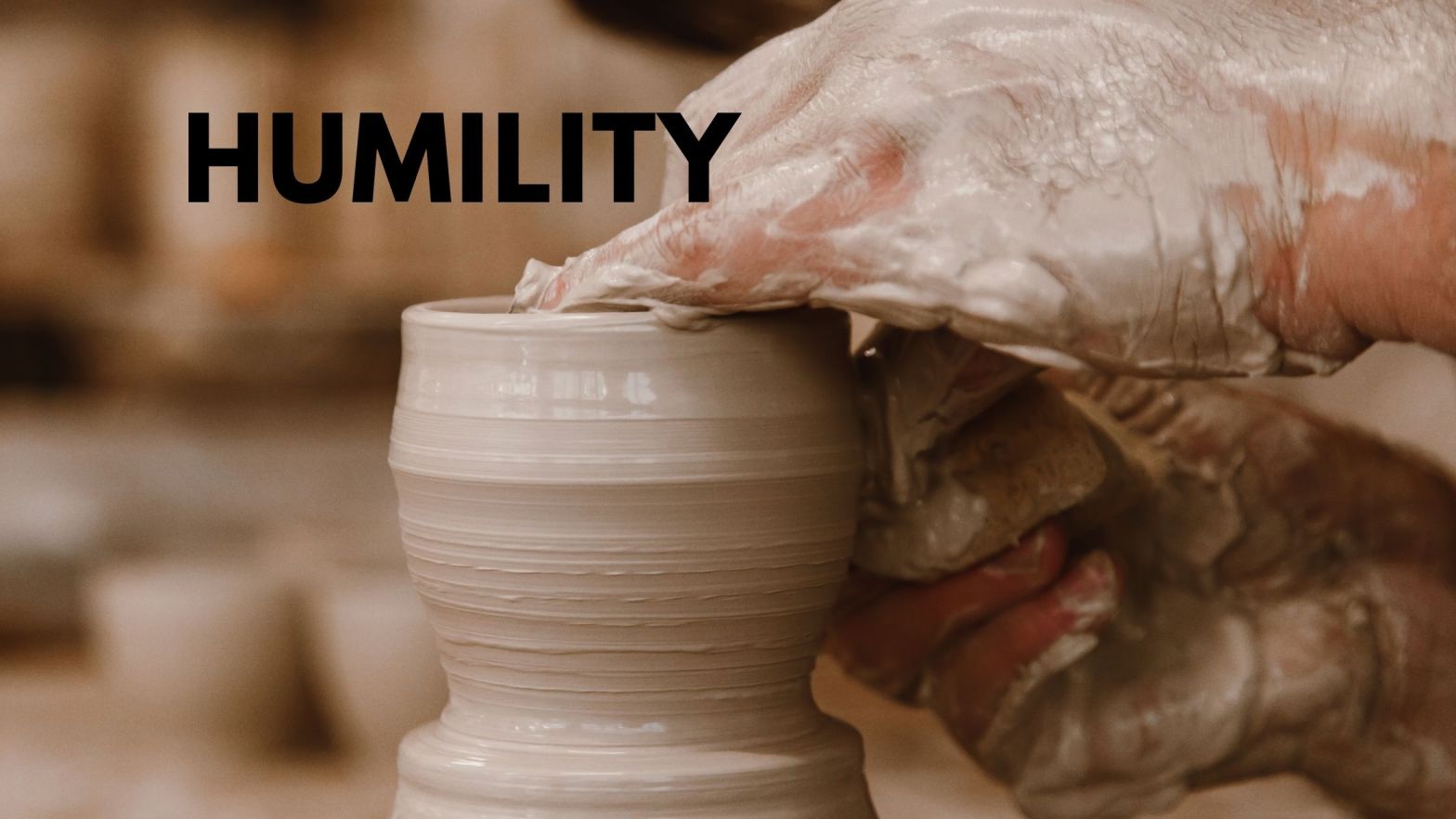
Yet you, LORD, are our Father. We are the clay, you are the potter; we are all the work of your hand.
Humility is that surrendered position of submission to God’s sovereignty, to his plan, to his moulding and shaping, that comes from that healthy fear of the Lord. It is the position that was taken by Jesus, the one who can say, “Learn from me”, because he is the ultimate expression of humility, as expressed in his words in Luke 22:42
Yet not my will, but yours be done.
 free2follow